Tim Winton gave a talk at the Adelaide Convention Centre last night – Tender Hearts, Sons of Brutes – as part of his tour to promote his latest book. The place was packed.

Winton is an iconic Australian author. I remember when we first moved here, I wanted to immerse myself in Australian culture and literature, and was promptly pointed in his direction. I started with Cloudstreet and have never looked back. In 2007, he was named a Living Treasure by the National Trust and has won the Miles Franklin Award four times.

The protagonist in The Shepherd’s Hut is Jaxie Clackton, a young boy searching for a better way to be, having learnt everything about being a man from his dad, a brute and a bully, and so has been shaped by, and marinated in, violence, as Winton shared:

I think we forget or simply don’t notice the ways in which men, too, are shackled by misogyny. It narrows their lives. Distorts them. And that sort of damage radiates; it travels, just as trauma is embedded and travels through families.

Winton opened the session with an extract from the book speaking as Jaxie, explaining how he now knows what he wants but has ‘been through fire to get here’. For Winton, a novel is not a tool but a toy; something to explore with curiosity because ‘useless stuff resonates, experiences linger’ – ‘useless beauty’ is why he writes. He’d planned to write the story from three or four people’s perspectives, but it didn’t work because all he could hear was the voice of the ‘unlovely boy’ and so gave him the floor.
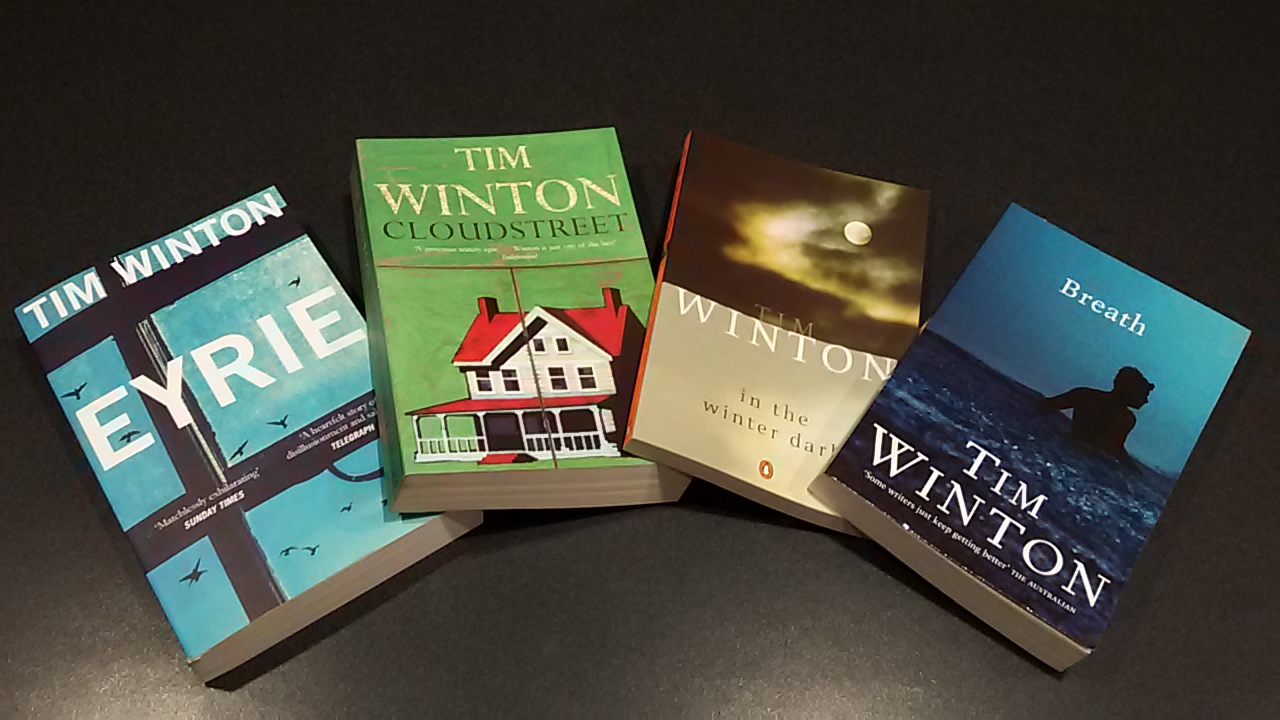
Having read only six of his twenty-nine books (Dirt Music and Minimum of Two I borrowed from friends), I still have some reading to do. His writing is inspirational with a focus on landscape and place (his novel In the Winter Dark spurred me to write a poem called ‘primordial’ I’m rather proud of and is currently finding a home).

Winton spoke well to a captivated crowd, exploring childhood, identity, poisonous masculinity, domestic violence:

In this airless universe there are no conversations, only declarations and fraught silences

and was humble, describing himself as ‘just a storyteller’, a brilliantly iconic one at that.
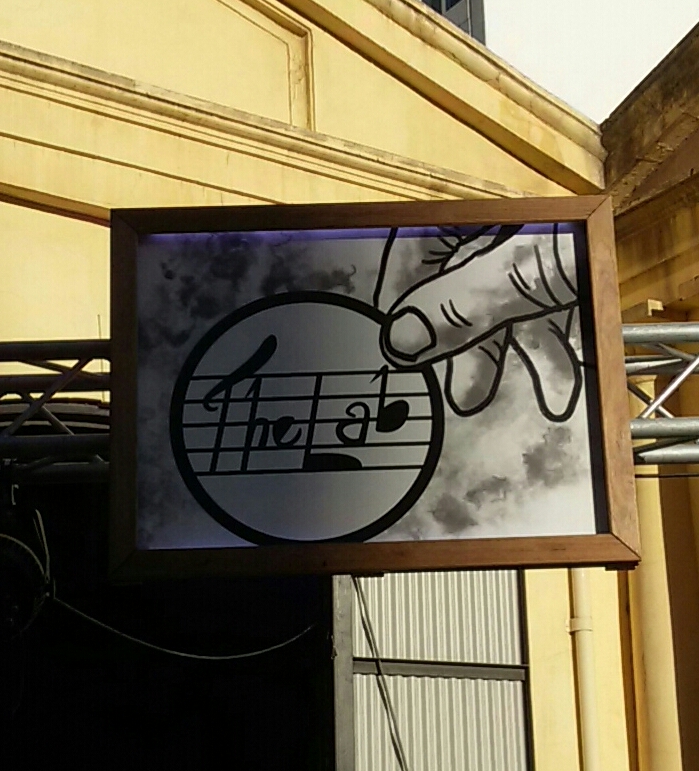
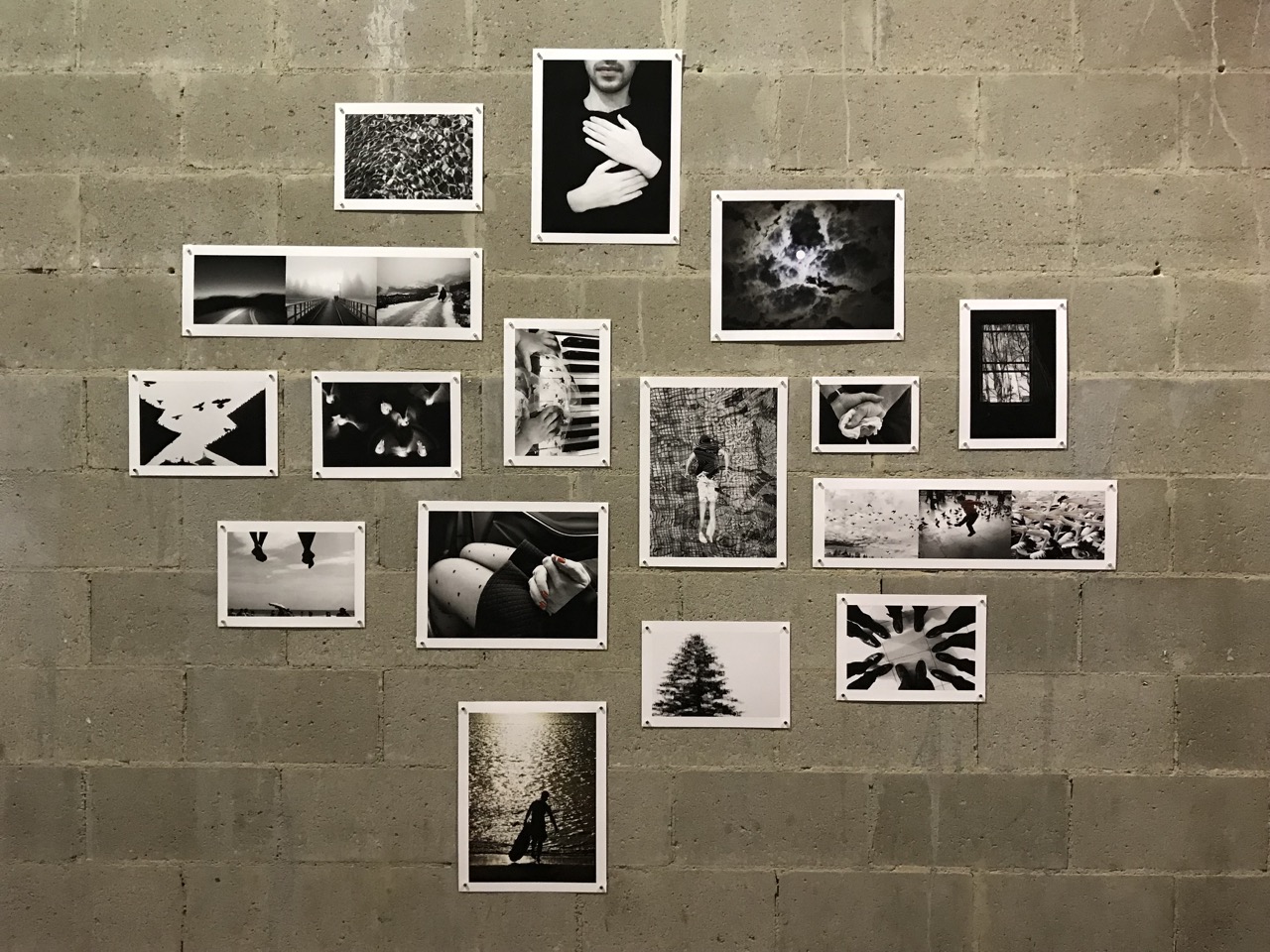
Having reviewed her son’s show, Susan Belperio asked if I’d review her photography exhibition, Under the Lens, currently on display at the same venue, The Lab, Queen’s Theatre.

A former medical practitioner and in addition to here, Susan’s work has been displayed in Queensland and the Northern Territory; she also had an image in a human rights exhibition in Tibet opened by the Dalai Lama.

For me, the exhibition comprises three parts, beginning with a stunning black and white photo of Josh either dressing or undressing for his show (it’s the voyeur’s choice), revealing the eight-inch scar travelling his skin. It’s an intimate scene, one of a mother portraying the glittering remnant of her son’s near-death experience.

In the cluster of black and white images that follow, hands and feet feature, snapshots of movement stilled. Two pairs of feet dangle carefreely from a balcony overlooking the beach. A pair of hands are clasped on a lap, the red painted nails the only colour calling. A circle of polished feet appears as if talking and a child’s hands are being introduced to the piano. Interspersed with images of the moon, birds, roads and the sea, they denote a journey well-travelled, be it flying, driving or sailing, elements that lead neatly into the final part.

The colour series is called Life’s a Beach, in which Susan conveys the multi-faceted sea, what it can give and take away. It’s a colour spangled dreamscape with each image expertly placed to both singularly shine and complement its neighbours. Humans are juxtaposed with the man-made and wild – the shadow of a plane over water, a lone feather, a child’s spade in the shallows, the ripples and twists found in the sand and sky. The sea dons day and night, carries time effortlessly, simultaneously evoking a distant longing and home.

Susan has an incredible ability to capture the everyday in a way that is not, to present indelible moments, to stop and embrace life. The exhibition, which is free to view, only runs until 17 March as part of the Fringe, so if you’d like to immerse yourself in some hauntingly beautiful images, I highly recommend a visit.

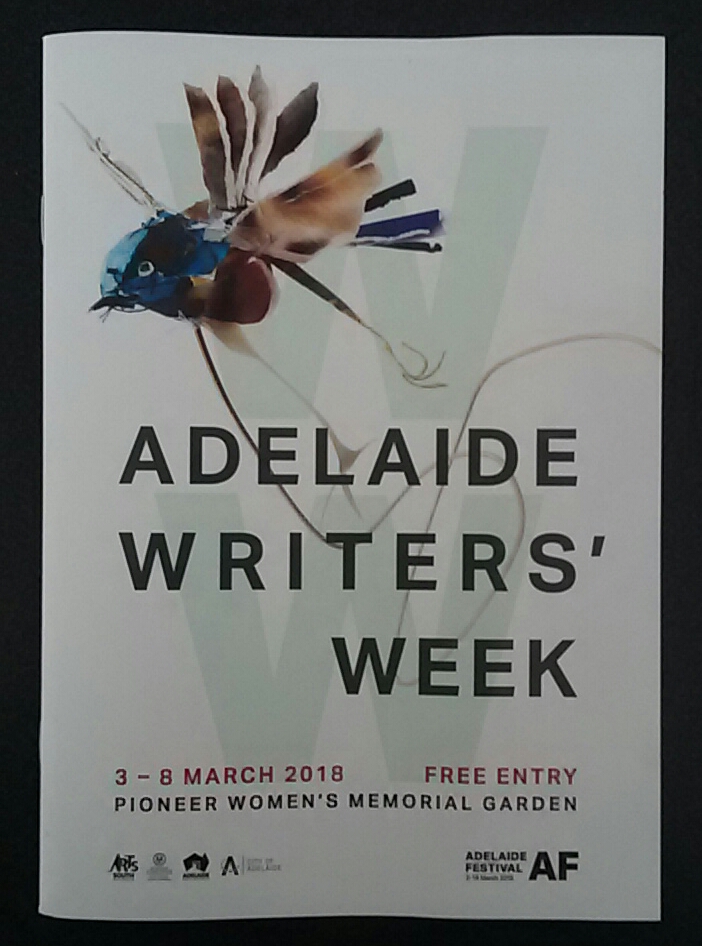
This took place yesterday in the Pioneer Women’s Memorial Garden, as part of Adelaide Writer’s Week, with a spectacular line-up – Alison Flett, Nelson Hedditch, Rachael Mead, Rob Walker and Manal Younus.

Facilitated by Peter Goldsworthy, a stalwart of the South Australian poetry scene, each poet was introduced to share some of their work with a packed audience. Alison was up first.

I love Alison’s work, particularly her fox and vessel poems, of which, among others, she shared both. ‘Liminoid’ is from Semiosphere, Alison’s Little Windows chapbook, and describes an encounter with a fox where there was still all the noise going on around me but there was a pencil line of silence running between me and the fox.

Alison then shared the first part of the trilogy ‘Vessel’, which symbolises the stages of womanhood and opens with:

No one else              has seen inside        this child.

She is small. The sky does            not yet            come down

around her.   It is still           contained

in a blue strip            at the top       of the page.

Nelson was up next, a performance poet I wasn’t familiar with, who has a passion for rhythm and words, which punched through. With his collection Never Finish Anything, Nelson began with ‘End to the Means’, which, like any brilliant performance poet, he recited from memory. ‘Homeostasis’ slowed down the pace from a song, ending in the line when I was born, I looked into my dad’s eyes like I’d been here before. Nelson also shared a poem written by his grandmother, ‘Words are dry shells, which presented a series of evocative images. When not poeting, Nelson is a hip-hop artist by the name of Dialect, at which I’m sure he’s just as talented.

Third to read was Rachael, another of my favourite poets, sharing some of my favourites too, starting with ‘The wild grammar of leeches’ from her new collection The Flaw in the Pattern, UWA Publishing :

I shed my clothes like an awful first draft, splashing river

on my face and into places used to their own company…

I look down to find my body being edited, its pages

harshly corrected with black punctuation.

Rachael also read ‘Powerless’, an award-winning poem I’ve shared on here recently from the Grieve Anthology along with ‘The dog, the blackbird and the anxious mind’, which was published in Meanjin, where while walking the dog, he drags me like I’m emotional baggage he’s desperate to escape.

Rob took to the podium next, again whose work I admire. He opened with ‘An accident waiting to happen’ from his collection Tropeland, Five Islands Press, which relayed a series of bad things, including I am the scissors in the hand of the running child. Rob also read ‘A Clarity of Smog’, which won Friendly Street Poet’s Satura Prize in 2015 (the year one of my own was shortlisted), followed by ‘radiology’ from his chapbook Policies & Procedures, Garron Publishing, where:

holding our futures in nervous hands

we come with xrays – ikons

in large envelopes with corporate logos…


this arcane analysis

reading the stars within…

Manal finished the set, another unfamiliar poet to me, her poise and delivery impeccable. Manal began with ‘Girl’, in honour of International Women’s Day tomorrow, further emphasised by the readings being held where they were. A particularly poignant piece, it compared woman to tree where ‘flowers are bi-products’ culminating in the stunning lines:

The burden is not who you are

but who you are asked to be.

Manal then shared a poem she had performed earlier that day, ‘Colour me in’, at a high school, in which we’re asked to colour me kind, colour me strong and colour me conscience so I see things others do not.

The readings were followed by the essential book buying and signing, so once again, I’ve got me some reading to do!

So I went to review my second Fringe show Friday night for mindshareScarred for Life at The Lab, Queen’s Theatre.

With the headline Man falls off bike, becomes star, Josh Belperio relays the time he flew over the handlebars of his bicycle, ruptured his spleen and nearly bled to death through a series of comical and clever songs on the piano, reminiscent of Tim Minchin.

Josh began by taking us back to when he was little, where he was held back in ‘fun skills’ because of his slight touch of autism, before finding his place at the piano and then falling from it (literally), which won him $500 in Australia’s Funniest Home Videos courtesy of his mum filming it. His first scar came at 15 from running through a plate glass door, severing the tendon and artery, with thankfully no nerve damage.

The day of his accident he was anxious and rushing to the Festival Theatre to workshop ‘The Unmentionable Musical’ as he calls it, approached a roundabout too fast, as did a car from his right. He slammed on his brakes. The bike stopped, he didn’t. And as he gets to his feet he feels strange, as if his body’s trying to process something, all this to terse music.

At home his parents (both doctors) put him to bed and monitor him, until Josh wakes feeling strange again. His mother takes one look at him and rushes him to hospital, not before Josh collapses and asks his boyfriend Matthew am I dying? A CT scan reveals a ruptured spleen, which requires immediate surgery and as the mask comes down, all Josh can think of is all the music he has left to write.

Having lost 2 litres of blood, Josh is transferred to ICU, which is the title of a highly entertaining song through the eyes of the ICU nurse, followed by ‘Sample pack of information for families of deceased patients – spare copies’ where Josh summarises each pamphlet inside. My favourite song was ‘Watching me pee into a bottle’, a tender exchange between Josh and Matthew, in which love and affection grows like my urinal collection.

Towards the end Josh reveals his eight-inch medical marvel (his scar), an angry looking welt, which he thinks ugly, but to Matthew it’s beautiful because it represents how his life was saved. The mental health aspect of the show is anxiety and how Josh manages it – present before his accident and escalating after – to enable him to live the life he wants, to not be scared, to make peace with his scar and most importantly, to get back on his bike. Josh is a talented artist, and gave a funny and moving performance through theatrical song. It’s a show I’d recommend.

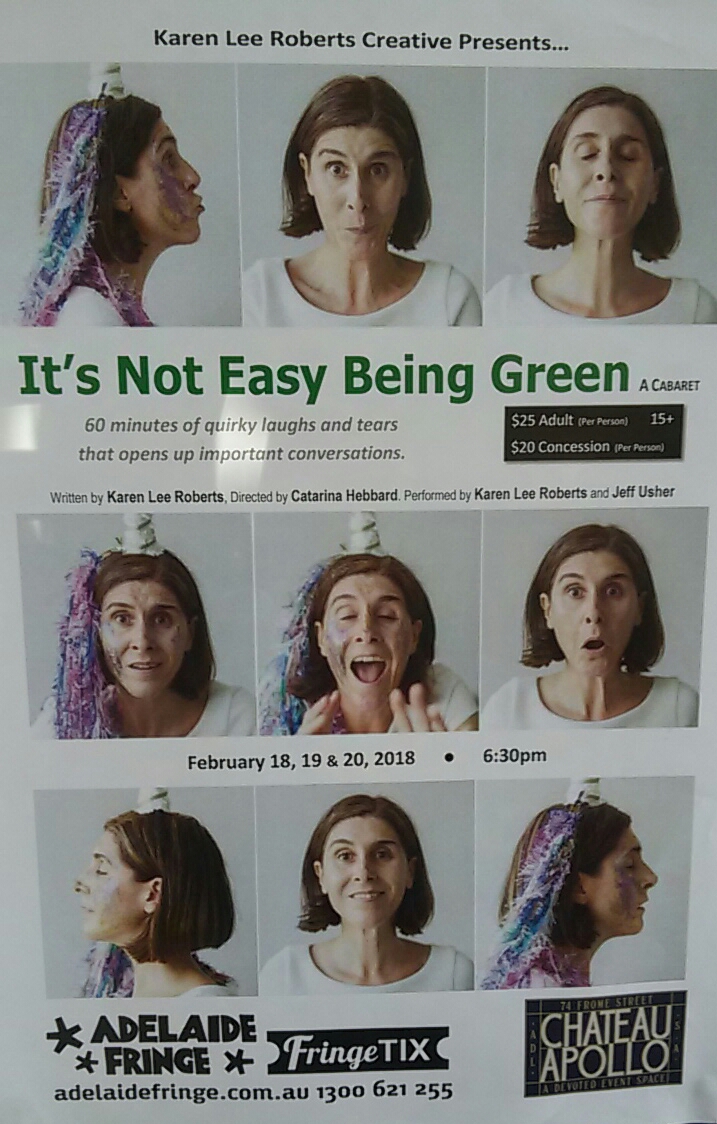
As a Fringe reviewer of shows with a mental health theme for mindshare, I went along to my first one Monday night; It’s Not Easy Being Green, a cabaret at the Chateaux Apollo.

Written and performed by Karen Lee Roberts accompanied by Mr Sunshine (aka Jeff Usher) on keys, it was an insight into a struggle with mental wellness (not illness) via a series of scenes, opening with Christmas Eve where everything was unravelling. Karen, in character, compared her state of mind to algae – green and always on edge, waiting to be devoured by something bigger – and talked about how depression is still taboo, asking can’t people bear to hear the truth??

Each scene explored acceptable conversation versus reality – the dinner party where she declared the food far better than what she’d received in hospital when mentally unstable; the photos of her wedding in which professionals expertly covered her self-harming scars; and the change in her behaviour when she came off her meds, the dark places she visited trapped by her myriads of faults and flaws.

And each snapshot was framed in song – ‘Problem solver’ and ‘Chameleon’ to name a few, the latter advising to keep your skin, don’t rearrange, a poignant message. Karen had an amazing voice pitched with feeling, all songs self-written to be made into a CD shortly. Then my husband became part of the show being invited on stage to play Daniel, the guy she’d met on Tinder, an amusing interlude to say the least!

The hour offered a raw, honest account of a person stripped bare – juggling demons, meds and their inevitable side effects with healthy eating, exercise and positive action – and revisited the Christmas Eve scene, a clever bookend, where the tree in the distance no longer represented something to hang from, but life itself.

I’m not a big fan of cabaret, so this wasn’t a show I chose to review, but because of its ability to leap beyond comfy mental health, I’m glad I did. Unfortunately the last performance was yesterday (it ran for three nights only), but if it returns next year I’d recommend the experience. Until then I’ll leave you with the closing line – it’s not easy being green, but it’s better than being blue.     

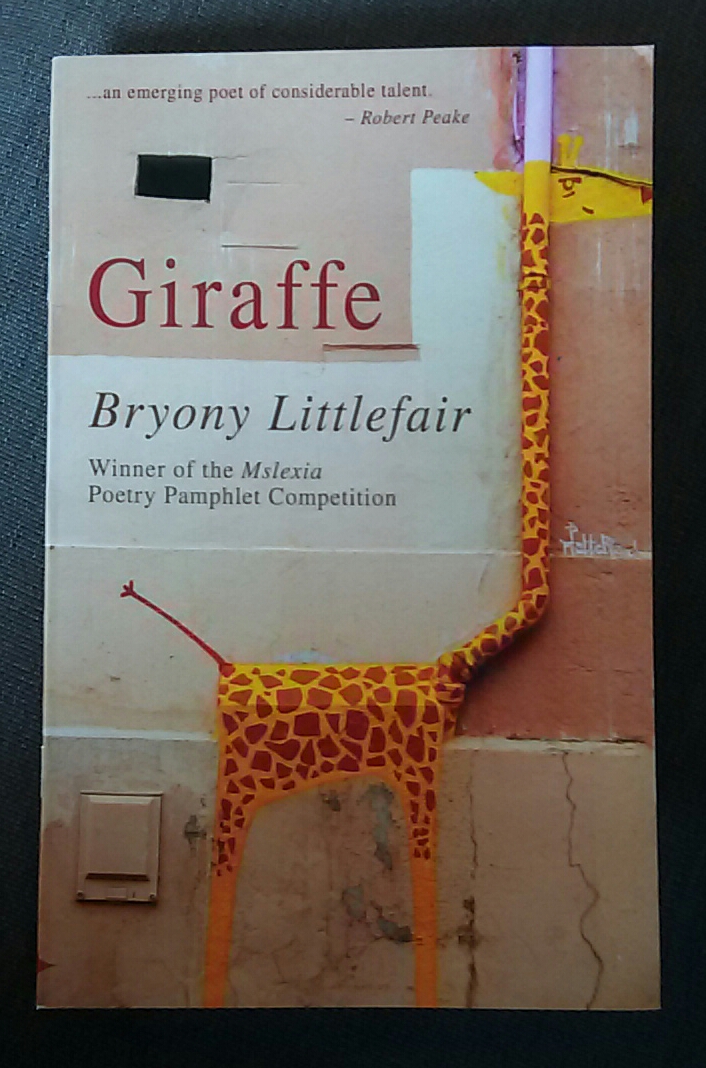
Giraffe is Bryony Littlefair’s fantastic debut collection. Published by Seren Books, it won the Mslexia Poetry Pamphlet Competition in 2017 and it’s easy to see why.

Through 19 poems, Bryony skillfully presents everyday life – from ‘Tara Miller’, the bad girl at school who leaves an impression to the lesson of healing in the title poem, where happiness when it comes “will be long-legged, sun-dappled: a giraffe.” We’re pulled into each scene, but it’s the insightful nuances that make these poems shine.

In ‘Dear Anne Monroe, Healthcare Assistant’, Bryony relays her sister’s blood-taking (somewhat apologetically) through the eyes of the nurse:

Sorry for her ratchety stubborn fear,

which will make you late for your next appointment. Sorry, also,

for the 16k a year, for the commute

from Clapham North to Archway

where the light is piss-yellow and everyone is angry.

Coming home early from school in ‘Hallway’, Bryony catches her mother “eyes closed, somewhere else” playing the piano as Bryony:

…stood quiet and uncertain,

shivering like a just-plucked violin string;

washed up in the hallway, wondering at her life.

It’s an absorbing collection – a series of expertly rendered snapshots in which Bryony punctuates conversational tone with poignancy. I’ll end with one of my favourites, for just this reason.


Amsterdam, July 2011     


I might have stayed, in that lighted carriage,

with its lullaby of whirring tracks, but stepped off here,

where the girls stare out from glass

as though they know your secrets, as though

they are okay with them.


The streets sing hymns here. The buildings talk quietly amongst themselves.

You check out early. There is no breakfast. Fuelled

by hunger, you can go and go. The ecstasy

of open space declares itself, and knows

of your relentless need to run roads.


Loneliness does not exist here, where every face looks like

one you might have loved in a previous life.

Undrunk vodka. Sky cool in my throat.


Like an empty suitcase, my heart flies open.


Copyright @ Bryony Littlefair 2017

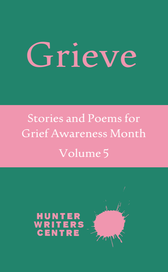
The Grieve Writing Project is facilitated by the Hunter Writers Centre, and offers people an opportunity to write a poem or short story about their experience of loss and grief. Around 120 pieces are selected for publication each year in the Grieve Anthology, with the readings and awards held in August, Grief Awareness Month in Australia. Last year I responded to their submission call and one of my poems was included in the e-version of the book.

We all experience loss at one time or another; some more than others and at varying degrees. I lost my Dad to cancer in 2007 (it’s a funny expression, as if I’ve been trying to find him since). His death was sudden, somewhat unusual with cancer – primary in the bowel and secondary in the liver, which was ironic considering he was in a bowel-screening program. My Dad was a beautiful man and his going so soon hit me hard, as it did other members of my family. So my poem was about him; I’ll share it here:


Because


you’ve gone Dad, I’m arranging a new one

mending myself to you piece by fabricated piece.


I begin with your feet, position your once white

trainers so you’re surveying the back garden


what to trim and weed. Next, the grass-stained

paint-splattered jeans you wore at weekends


to do odd jobs around the house, which always

took you longer than planned. To finish, a red


sweater that hints of you, even now. All you

need is a little life. Closing the wardrobe


I swear I see your foot twitch, picture you smiling

at me like the last time I saw you, which I knew


would be the last. I tie your laces, just in case.

Copyright © J V Birch 2018


The anthology is an emotive read of fearless writing – poems and stories of grief and loss from authors who, from their own painful experiences, have bravely revisited and crafted them to share an amazing variety of pieces. It’s the kind of read that can overwhelm if not prepared; it left me with a profound sense of connection.

And I’ll leave you with one of my favourites by Rachael Mead, an extremely talented poet and very good friend, whose poem won the National Association of Loss and Grief (NALAG) Award:


Powerless


Three days without power and the only sounds

are wind, rain and the hiss of flame beneath the kettle.


I don’t mind. Quiet is the road blocked by tree-fall,

reminding us that electricity is not the fifth element.


I am reading on the couch when our neighbour

knocks.                      Tom has died, she says.


It’s the final erasure of that disease, the one

that eventually steals everything, from his last


conversation to the memory of his wife of 60 years.

She is strong but after she leaves the grey air


seems especially sad and even a little jagged.

The world is not what we want. Our minds,


those tender, playful muscles stiffen and seize,

however hard we work at making ourselves


original. Beyond the glass, the green earth

blurs with rain, the trees bend and crack


in allegories of wind.            My heart folds

and folds itself down into a tiny yet infinitely


dense thing: a grain of sand, a mote of dust,

a faraway star we all know full well is dead.

Copyright © Rachael Mead 2017

I was guest poet at Poets’ Corner Monday evening, a bi-monthly event held at the Effective Living Centre in Wayville, and thoroughly enjoyed it.

Having been recommended by Jules Leigh Koch, fellow poet, friend and a member of the group, Mary Taylor who runs the event invited me to read, which I managed to do for an hour! The centre is celebrating its 20th anniversary this year and the evening drew a small, but attentive audience.

Preparing for it, a few themes emerged – family, health and travel – so I structured my reading around them. I started by talking about my background, how I got into poetry, shared my first published poem (a whole nine lines!), and then my thoughts on the purpose of poetry and my creative process. I read 22 poems in all; some from my chapbooks and a few from the collection I’m currently working on. Questions followed.

Louise Nicholas, another fellow poet and friend, wanted to know how I can be so disciplined with my writing routine. Being fortunate enough to work part time, Fridays are my writing day, plus I love to do lists and so make one for what I want to achieve that week. And if I do something not on the list, I add it on and strike it through! (does wonders for the sense of achievement). I was also asked how I find out about submission opportunities. I’ve signed up to a weekly email, Submishmash, which lists upcoming deadlines for both national and overseas publications seeking work, and also hear about them through my poetry groups, with Facebook being a valuable source too. However, I plan to cut back on the number of submissions I make this year to focus on my next (and first full length!) collection.

It was a wonderful evening and I was surprised how quickly the time went. There was a short break followed by an open mic session in which others shared their own work. I sold a few chapbooks and had some interesting, and insightful, conversations. And that’s one of the many beautiful things about poetry – its power to bring people together, which sometimes, in itself, is enough.

I went to a workshop yesterday facilitated by Jane Turner Goldsmith at Adelaide University called ‘Write Yourself’.

Jane is a psychologist as well as a talented writer, who I first heard speak at Salisbury Writer’s Festival a few years ago. Having had a synopsis accepted by the Australian Psychological Society, Jane was keen to try out her workshop before rolling it out to a wider audience. I was one of six who volunteered and very happy I did.

Writing as therapy is a hot topic, with research by Pennebaker showing the therapeutic benefits associated with this particular form of self-expression, both mental and physical. In six hours, we completed 10 exercises, ranging from writing about something we were proud of and the significant object we were asked to bring along, through to eating chocolate mindfully and introducing narrative to a traumatic event. One of my favourites, and the most emotive for me, was writing a letter to our younger selves. When time was called, I couldn’t stop.

Parameters were given from the start. No one had to share what they’d written, only if they felt comfortable doing so. Some did, others chose not to. Jane was also interested in how we felt about completing each exercise – anxious, scared, enthused – to gauge how they’d be received. And this is the important bit.

As said, Jane is a registered psychologist with extensive experience in this area and so was very adept at managing the emotional consequences of such self-exploration. I’ve recently assisted a fellow writer in the UK, Carolyn Jess-Cooke, to publish an article in the latest issue of Mslexia about the safeguards in place when writing about mental health, and how alarmingly many running such workshops are not adequately equipped to deal with the fallout. Fortunately, I was able to provide examples of good practice here.

For me, the workshop was emotionally exhausting. I revisited traumas and even went places I’d never been. But then I didn’t expect anything less. Being a poet who draws on experience to produce work, this was safe ground. And completing the exercises has given me the foundations for five pieces I intend to develop further. So thanks again Jane for letting me be one of your guinea pigs. I’ve found new squeaks 😊

No, not quite, as this all took place in the latter half of last year, but the new one prompted me to look back on the changes I’d made, the impact they’ve had and thought I’d share them with you.

It actually all started the year before, so 2016, when I went to the doctors to discuss the side-effects of the medication I was on for my endometriosis (I believed they were making me short-tempered, moody, etc.), however, she explained that due to the low dosage of each of them, it was unlikely they were the cause.

She then asked me if anything had changed in my life recently, to which I replied I now work part time and use Fridays to focus on my writing, had joined three poetry groups, started an online course and was finalising my second collection. She pointed out that in actual fact I work full time and had taken on additional commitments, and I thought, well yes, if you put it like that (isn’t it funny how it takes someone else to point out these things and the different perceptions of writing as work?)

Anyway, it got me thinking, and I concluded that I only get stressed, ratty, etc. when I try to do too much, and the only person putting pressure on me, was me. For example, I like to exercise three times a week and if I didn’t achieve this, I’d feel guilty. One of the days I exercised was a Friday followed by the whole beauty regime (you know what I mean), doing some washing, tidying, making appointments, responding to emails, etc. so that before I knew it, it was nearly lunchtime. What was I doing…this is my writing day!

Still on the topic of exercise, I used to drive into work on the days I did it because I thought it quicker, so typically Mondays and Wednesdays to complement the Friday. Driving into the city from where we live at peak time is extremely frustrating (yes, even here). A 16km trip can take over an hour. And so I’d rush in, struggle to find a park, work, rush home, exercise, cook dinner, eat and then have little energy to do anything else before bed.

So, over the months that followed, I gradually made changes. I now exercise on a Saturday morning instead of a Friday, freeing up the latter to do what I should be doing, poetry.

I no longer drive into work. I cycle to the train station some ten minutes from our house (so exercise in itself albeit small), store my bike in the locker I rent and take the train in, where I can read, write, check messages, listen to music, even nap if it’s quiet enough.

We’ve started using Hello Fresh, a meal service which delivers the ingredients to make three meals a week to our door, which in turn avoids that age-old question “what are we having for dinner tonight?!” and eating the same thing.

I’ve also negotiated to work from home every Wednesday because with access to systems, I can do my job anywhere. This, I feel, has been the biggest change and is helping me to manage my endometriosis (i.e. less travel, less rush, less stress), which appears to be flaring up again annoyingly.

Small changes have made a significant impact. Coupled with taking things easier and not trying to do everything at once (because who is chasing me for it – no one!) has made me a happier, less stressed, more balanced person (cue sigh of relief from husband). So, my message to you? It’s your life, make of it the best you can.

Archives

Blog Stats

  • 25,422 hits
Rust & Moth

Singing in the shallows

Shaw and Moore

Singing in the shallows

The Orange & Bee

Singing in the shallows

The Amphibian Literary and Art Journal

for the culturally amphibious

Poetry in Process

Understanding poetic process from inspiration to final edit

Wakefield Press

Wakefield Press blog

Andy Jackson

Poetry from a body shaped like a question mark.

mistakenforarealpoet

odd posts from an occasional poet (or vice versa)

Cath Drake writing & communications

This site has been archived. Please head over to: https://cathdrake.com/