You are currently browsing the category archive for the ‘Festivals’ category.
Having been invited as a guest speaker in a writer’s festival run by Banksia Park International High School to inspire students to write, this was my first school talk and I must admit, I thoroughly enjoyed it!
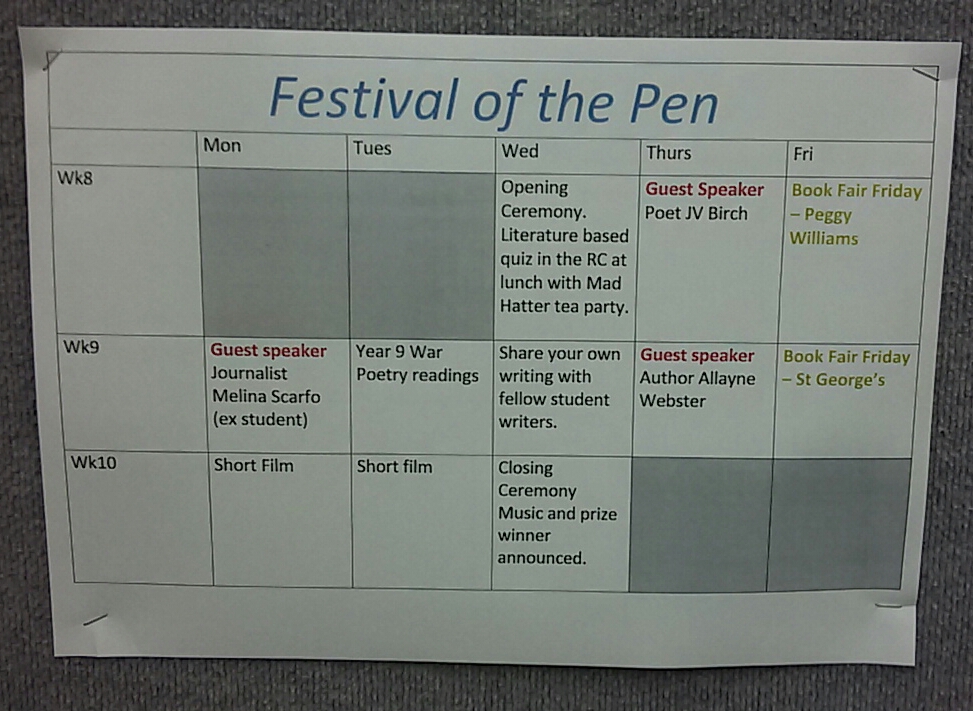
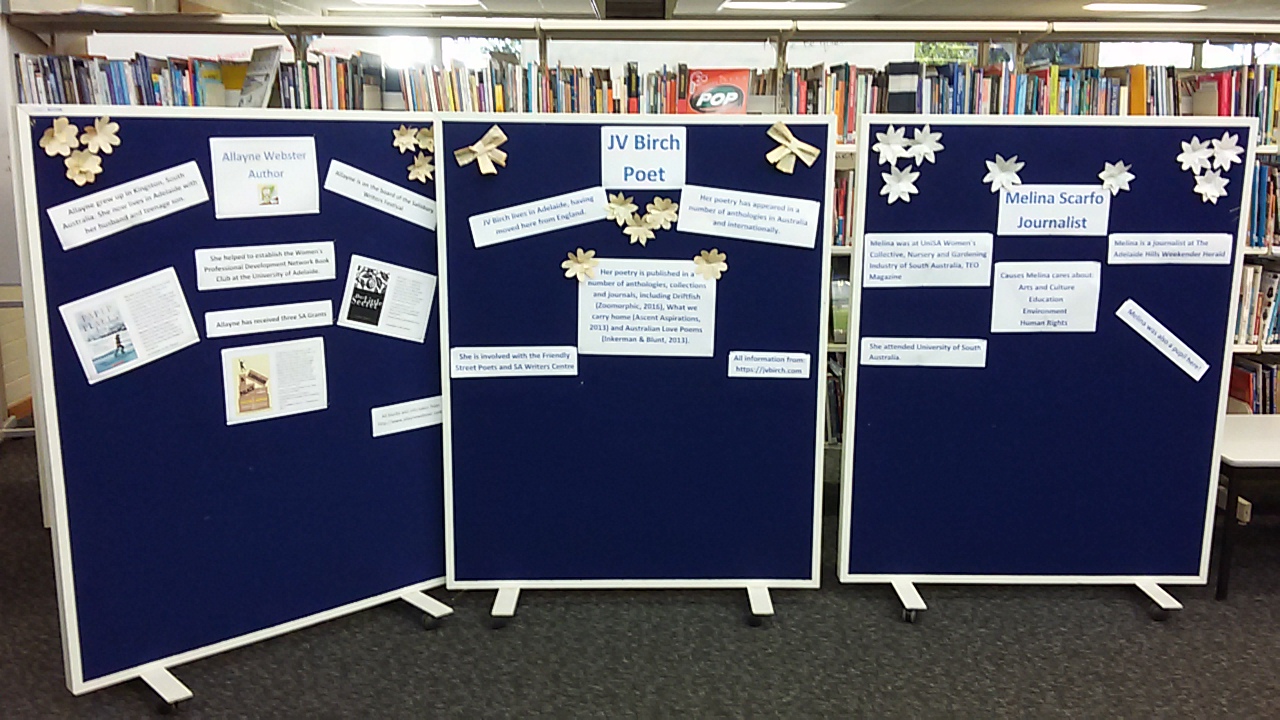
Mine was the first session in the program after its official opening on Wednesday, with other sessions by a journalist and author taking place next week. The school is in a part of Adelaide I’d never visited before and Marika, the English Coordinator who’d contacted me, led me to the Resource Centre where a wonderful space has been created for the festival.


About 15 students attended in their lunch break, ranging from 12 to 18 years old, who listened while I shared how I’d started writing, a little about the process I follow, some of my poems, finishing with a few hints and tips for those interested in pursuing poetry.
I asked those who write poetry what they like about it, to which one young boy replied “because I’m creating something”, supporting the idea that the poem is a living, breathing thing. One girl asked what sort of poetry I write, haiku, sonnet, etc. I replied “free form” – I prefer to write without constraint, to let the poem take the shape it wants, which prompted Marika to make a note to talk to the other teachers about letting the students write more poetry without having to adhere to a set of rules.
The school purchased a few copies of my chapbooks for their library and a couple of students took my contact details, so I’m hoping they’ll be in touch. Events like these are a brilliant way to engage the next generation in writing and provide some insight into taking the next step in their chosen craft. Fingers crossed they do 😊
Adelaide’s Writers’ Week kicks off this Saturday with an impressive program full of all things literary, so there’ll be something for everyone.

Held in the Pioneer Women’s Memorial Garden, there’ll be a plethora of poets, novelists, playwrights, historians, biographers and memoirists, all genres to captivate and challenge the crowd. Notable events are; Mike Ladd chatting about his recent collection of poetry, Invisible Mending, published by Wakefield Press; an interview with Ken Bolton, ‘a laconic and discursive poet’, aswell as art critic, editor and publisher; and the coveted poetry readings presented by Peter Goldsworthy, with a stunning line-up.
Jan Owen and Cath Kenneally, stalwarts of the South Australian poetry scene, are joined by Steve Brock, Jules Leigh Koch, Louise Nicholas and Dominic Symes. Jules and Louise I know well and are incredibly talented poets; Jan I’m learning an invaluable amount from through her monthly workshops; Cath and Steve I’m still relatively new to their work; and Dominic I believe is an up and coming poet, one to watch.
Unfortunately, however, I’ll be en route to New Zealand to explore the South Island so will miss the entire week! Note to self for next time – avoid holidays in March.
This year’s line-up at Adelaide Writers’ Week were all from South Australia – Aidan Coleman, Jelena Dinic, Jill Jones, Kate Llewellyn and Thom Sullivan – who shared poems from their own collections as well as from a poet who has influenced them.

Peter Goldsworthy compered the event, telling us about the new state-by-state anthologies from Australian Book Review (ABR), in which these poets feature, before moving on to introduce each of them.
Aidan opened the session with two poems from Asymmetry published by Brandl & Schlesinger Poetry, a collection that focuses on his painstaking recovery following a stroke. ‘To play’ is a parody of putting himself back together, asking us to ‘catch a face before it slides from the plate’ and in ‘New York’, the last poem in the collection, they were ‘leaving an afternoon of coloured glass and temples’. Next Aidan read his ‘Secondary’ series about these colours, where in ‘Green’ ‘lungs are scoured by brillo air’, ‘the heart is a wound or badge’ in ‘Purple’ and how ‘Orange’ ‘is the light of a cupped match.’ From his new chapbook, Cartoon Snow available from Garron Publishing, Aidan read the title poem asking us to ‘go where a blue night is snowing to itself’ followed by ‘Barbarian studies’, where ‘kids jostle, shove and swing like wrecking balls’. Aidan’s influence was John Forbes, an Australian poet, and he finished with a poem of his own about motivational posters, where ‘scent falls upward like helium.’

Next up was Jelena whose work I just adore, influenced by Vasko Popa, a Serbian poet. Jelena started with ‘Dawn chorus’, a sinister poem about her ancestors from her chapbook, Buttons on my Dress also by Garron Publishing, where ‘under their tall hats time waits’ followed by ‘Visiting’, describing a time Jelena returned to her hometown culminating in the fantastic lines ‘Lamp-lit photographs are mute. I pretend to know the answer’. Next up was ‘Wedding’ where she asks the obligatory question ‘stepping on his foot just in case’ and then one of my favourites ‘Portrait of Olympia the Prostitute’ which is just that, ‘her black-cat eyes mastering the craft of the second hand love.’ ‘Ballad retold’ was a longer piece from the chapbook, as well as its final one, in which she walks ‘fine lines where beauty hurts’. Jelena finished with a poem by Popa called ‘Before the game’, which she read in English and then Serbian, in particular for her parents in the audience.

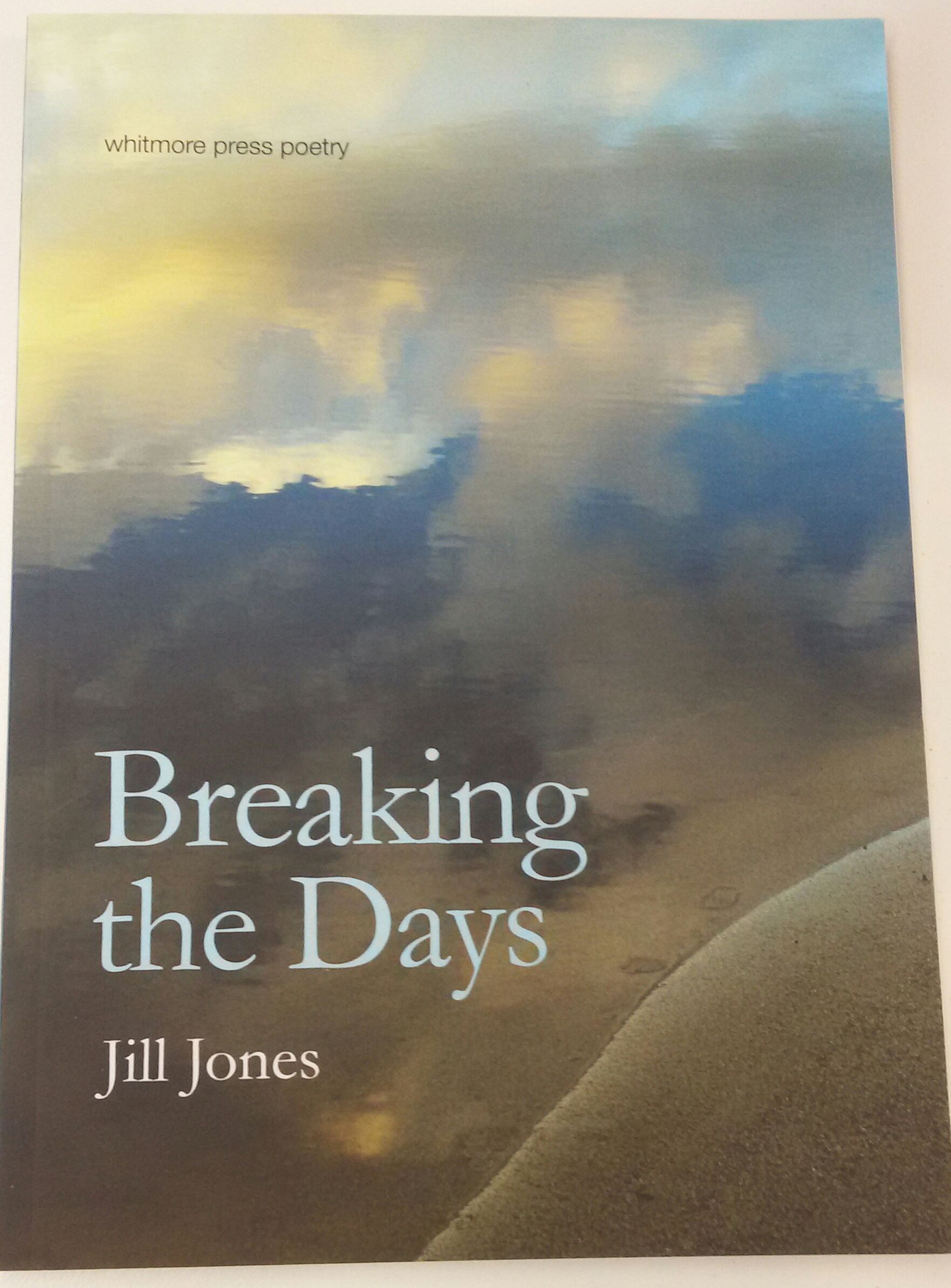
Jill’s work is exquisite, her poems have been described as ‘tapestries of the present’, and she didn’t fail to impress. She began however, with her influence Peter Gizzi an American poet producing layered poems both intimate and global. Jill then read ‘Bent’, her poem in ABR’s state anthology, where ‘I make sense then drop it, it gets dirty, it breaks, the ants carry it’, a very poignant piece and with the poems that followed, Jill went on to paint equally vivid images – ‘maps of rain and passage of stars’ and ‘the sky is as opaque as reality’. Jill shared a few poems from her new collection Breaking the Days published by Whitmore Press Poetry, starting with ‘Happy families where ‘your own genius spooks, it runs to the cupboard and breaks all the plates’, followed by a sense of separation in ‘Fractions’ where ‘you could be tempted to fold’ and in ‘Not all choices’, she is out ‘to relieve the dog of its chasing thought and the business in the head’.
Now I must admit Kate is new to me, I’ve not heard her read before, but she was introduced as SA’s most popular writer, known to her friends for her legendary letters. Kate started with ‘Harbour’ about both sailing into Sydney and growing old, where ‘the little casual things I see grow into a roar.’ Kate’s next poem ‘Dirt’ was very amusing, with which she falls in love through gardening, comparing it to Mr Right with a subtle rhyme throughout. In ‘Oxytocin’, included in the new ABR anthology, the line ‘last night I strode among the stars’ is repeated at intervals creating a profound effect and in ‘Seeds’ we hear the story of Demeter and Persephone, where the latter is a ‘creature of light, the sun and beaches’. Kate then read ‘Older men’, a poem she wrote years ago before, in her own words, she got old, where he is ‘courteous with your mother whom he could have married’, another humorous poem ending with the line ‘consider this a shopping list’. To compliment this, Kate finished with a poem by David Campbell, her influence, called ‘Younger women’ with their ‘blue stare of cool surprise’.
Thom I’ve heard before at Lee Marvin, and again was moved by the pieces he shared. After Peter spoke of Thom’s good use of colons to separate snatches of thought or dreams, he opened with a poem called ‘Homosuburbius’ and its repetitive line of ‘you’re dreaming still’, with ‘post boxes gagging junk mail’ and where ‘late night programming is flickering under their eyelids’. Thom’s next three poems were pastoral ones about his hometown in the hills presenting us with different aspects of it. In ‘Threshold’ there is ‘a fine grain of stars’ and in ‘Freehold’ there are ‘a pair of eagles riding the thermals’. The poet A R Ammons was one of Thom’s influences so he read one of his poems called ‘The city limits’ followed by a two-part one of his own called ‘Carte blanche’, where there is ‘death with a moon in her pocket’ to prove a poem can be serious without being solemn. Thom finished with his poem ‘Nothing doing’ from Australian Love Poems 2013 published by Inkerman & Blunt, where we find that ‘a bowerbird is hoarding memories’.
It was an amazing session (both the first and only one I will unfortunately have time to attend at this year’s Writers’ Week) with some damn fine poems, plenty to absorb and ponder.
So I thought I’d go along this year to see what it’s all about. Below are some highlights. Know now, this is long!

Opening night
Mayor Gillian Aldridge opened the festival at the Mawson Lakes Centre, where they were thrilled to have secured former Prime Minister Julia Gillard to talk about her recently published biography My Story published by Random House. Amazingly Julia wrote this in 6 weeks, explaining that she wanted to write it as soon as possible to use the immediacy of memory. There are a few messages Julia wanted to convey in this book – a positive impression of politics for young people, how and why she did what she did, a story of resilience. Once again Julia was in top form – she really is a fantastic speaker and indeed role model for many girls aspiring to be a political figure.
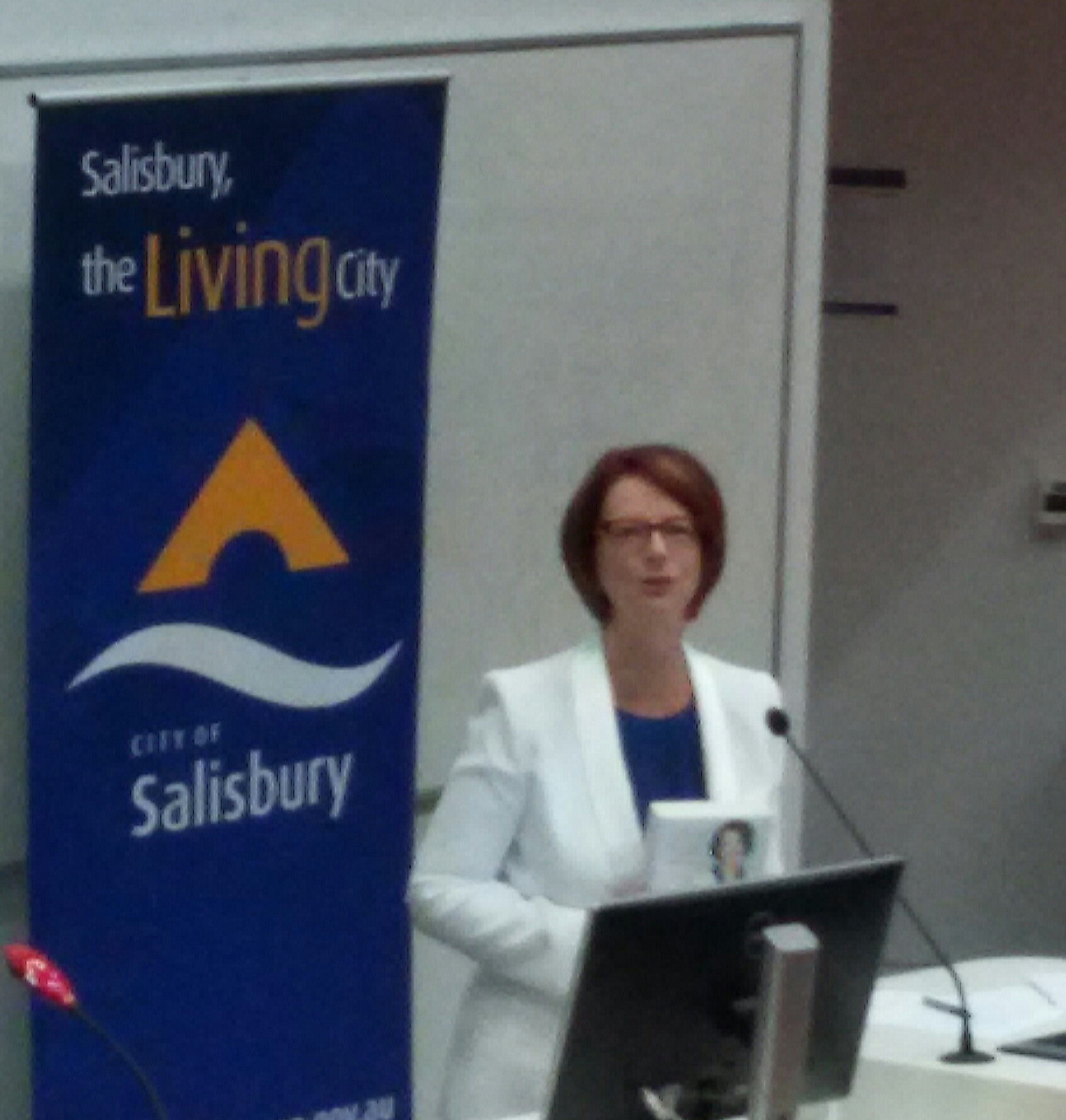
The launch of the anthology You’re Not Alone by young writers of True North also formed part of the evening, with participants asked onto stage to provide some context to the project, which essentially reaches out to anyone lost or lonely, or who are simply looking for a good story. It was a moving tribute.
Writers’ Forum
This was an all-day event of talks, debates and tips for writers across all genres, competency and experience.
Keynote address: William McInnes
Now I confess I was not familiar with this actor-turned writer, but was thoroughly entertained by what he had to say and how he did it!
William McInnes is one of Australia’s most popular authors, having written 8 books in 10 years, including memoir and his most recent novel, Holidays, published by Hachette Australia. William talked about the contrast between acting where you’re pretending to be someone else and writing, which is personal and all you. Above all, he said, the most important thing is that what you write means something to you, if not to anyone else, a point echoed throughout the day.
Panel: Writing as Therapy
This was an interesting discussion. The panel comprised, from left to right, William McInnes, Jane Turner Goldsmith and David Chapple from the SA Writers Centre, who between them explored the pros and cons of writing as a cathartic process.

Writing is putting yourself out there, often the most intimate parts, to be read, judged, critiqued, loved or simply ignored, which begs the question why do we put ourselves through it…
Writing is a means of expression, a tool to help manage, understand and heal us from traumatic events and experiences. It was interesting to hear that writing for therapy is only beneficial if there’s a strong narrative and resolution, giving an example where two groups were asked to write about something that has affected them, the first as a series of thoughts and the second as narrative, i.e. having a beginning, middle and end. The second group found this to be a satisfying exercise due to the structure imposed, whereas the first group felt they were just left swimming in a pool of emotion, proving this can be a dangerous exercise if not managed properly.
Writing can be subconscious, use characters or third person to reduce the anxiety associated with sharing, with writing fiction being a safe, protective environment to project the self. Even the most successful author can remain fragile about what they produce. I thought the closing remark poignant – people are designed to struggle, recover and move on; it’s what makes us human.
Panel: Once it’s out there…
This was essentially a hints and tips session from authors with books under their belt – from left to right Kristin Weidenbach, Carla Caruso, Jared Thomas and Mandy Macky from Dymocks. They explained how the world of publishing and marketing has changed, with publishers no longer able to finance extensive book tours.
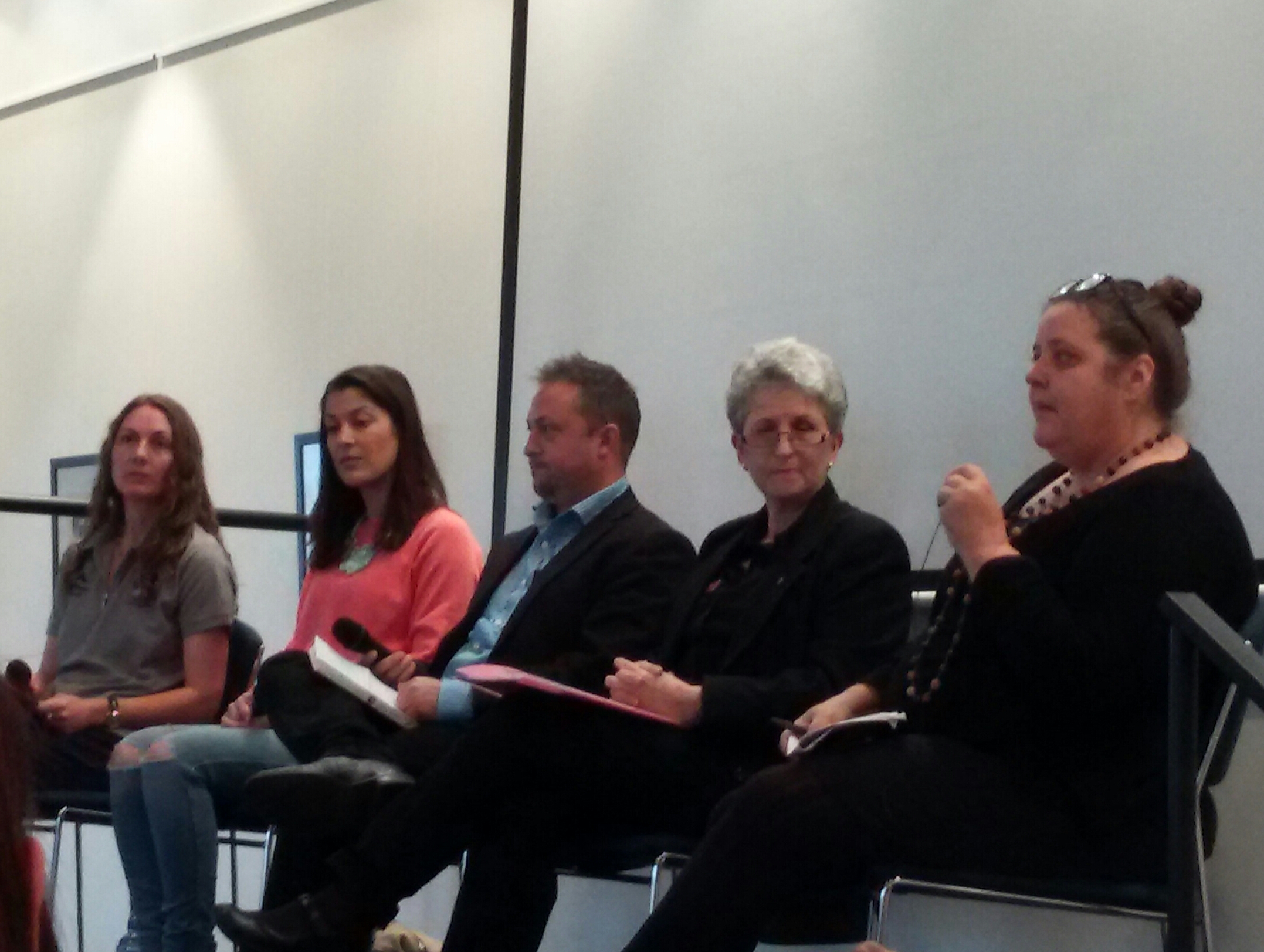
Here’s a little of what they said:
- Arrange your own launch as a means to celebrate and thank
- Cultivate a relationship with a local bookstore
- Seek speaking opportunities rather than just book signings
- Write articles for free
- Visit country/remote locations and touch base with the local paper
- Find a quirky angle in the media to advertise yourself
- Be reliable and easy to communicate with
- Know your genre and audience
- Network, make connections, attend literary events and festivals
- Literary agents are useful for negotiating internationally
The panel concluded by saying publishers look for authors who can market themselves as unfortunately, they no longer have the budget to do so.
Panel of Publishers: What goes on behind closed doors?
From left to right Michael Bollen of Wakefield Press, Sophie Hamley from Hachette Australia, Leonie Tyle from Tyle & Bateson Publishing and Dyan Blacklock a publishing consultant gave us an insight into a typical day, where reading new work is a small proportion and quite often done in their own time.
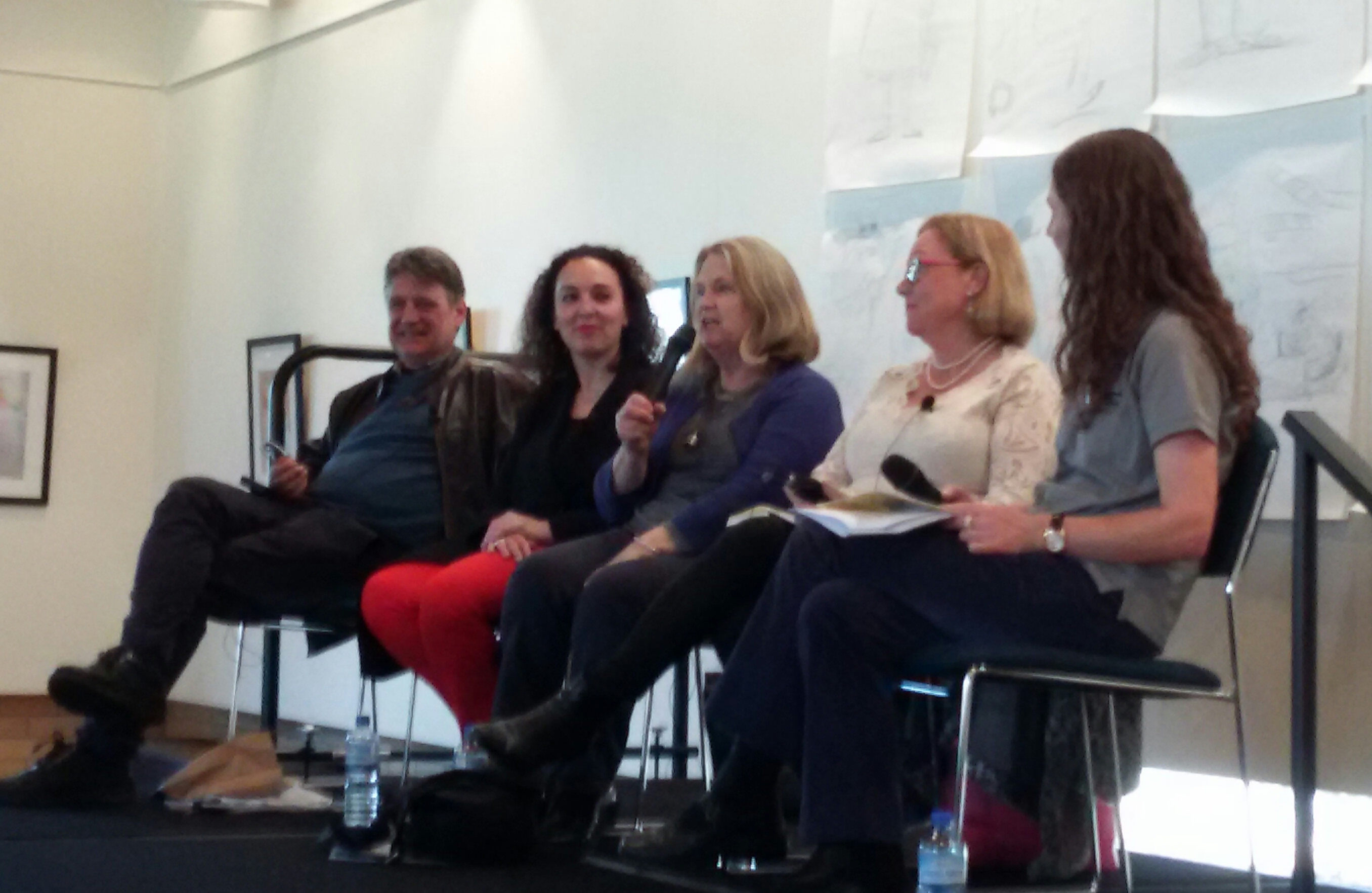
Liaising with account manages, sending books off to the printers, exploring cover designs, organising contracts, book signings, advising on book tours and launches, attending events, these were just some of the tasks cited that fill their day where, like many of us, there are never enough hours!
Usefully they shared some do’s and don’t when you think you’re ready to submit your work:
- Revise, revise, revise your manuscript
- Consider getting it edited professionally
- Be familiar with submission guidelines and process
- Do simultaneous submissions but be sure to let publishers know
- Know your market
- Apply for literary grants
- Enter competitions, join writing groups, attend events
- Explore the self-publishing option
- Assess how much you want print against the rise of e-books
- Beware of assessment agencies
- Write something worth reading, fresh and original
On this last point they strongly advised against writing what you think people want to read and a concept of ‘rear view publishing’ i.e. don’t write what’s already out there. And again another beautiful closing – a good book will always find it’s home.
The University of Canberra is hosting a Festival of Poetry from 1-11 September with fantastic international poets in residence, Philip Gross and Katharine Coles, along with a positively star-studded cast including the likes of Mark Tredinnick, Lisa Jacobson and Peter Rose.
The International Poetry Studies Institute carries out poetry-related research and publishes its findings across the world, along with journal issues and a chapbook series. Their aim is to “develop new communities of poetry and to make new links between poets wherever they are”, and this event will do just that.
Through a series of master classes, interviews, book launches and readings, including announcing winners of the 2015 University of Canberra VC’s International Poetry Prize, the program is jam-packed with opportunities to network, learn and appreciate poetry as the significant literary art form it is.
And if it weren’t for other poetry commitments around that time I would definitely go along, and then could have also ticked Canberra off being the only Australian city I have yet to explore! Alas, timing is everything.
Well I got me some done. Mainly because I was getting fed up of writing my details on any scrap of paper to hand, plus I do think it looks a little bit professional, don’t you?

So far I have parted with only a few – the obligatory one to the husband, and then a couple were given out at my recent trip to the Mildura Writers Festival, including one to Eileen Chong.
I do have more readings, festivals and workshops booked in to attend and participate in, including the launch of my first chapbook Smashed glass at midnight, so plenty more opportunities to spread the word of my own 🙂
And so the second session I attended at the Mildura Writers Festival was an insight into the work of Eileen Chong and Anthony Lawrence facilitated by Judith Beveridge.

I must confess I had never read either of their poems before and so was very keen to be introduced to them. Judith began by asking them how they write. Eileen explained how she allows a poem to ferment and doesn’t normally write until it is almost fully formed. She went onto confess she is a compulsive reader, books, packets, labels, really anything with words, and that she casts around for ideas to find a voice or mood to fit the subject matter. Anthony said his poems begin with an emotion, giving the example of driving from work one day when two gulls angled away from his fender and he knew at that point a poem was on its way. He also explained that he read a lot of lyrical poets, citing Leonard Cohen as one of his favourites (mine too!).
Both read poems about their grandmothers – Eileen about her paternal grandmother in ‘My Hakka Grandmother’ from her debut collection Burning Rice and Anthony read ‘Need’ from his forthcoming collection Wax Cathedral.

When asked by Judith about the actual process of writing, Eileen said she usually goes straight to the keyboard, whereas Anthony has a passion for paper and fountain pens, making meticulous changes by hand, although did confess that for his new collection he went straight to a Word document for the first time. Judith also explored if either have any particular rituals when writing, to which Eileen replied she has to have a clean house before starting and is not able to write if she’s anxious about something. Anthony said he can write anywhere without need for a formal structure and read a poem called ‘Murmuration’ about the movement of starlings. Eileen also read a poem from her forthcoming collection Painting Red Orchids to be published by Pitt Street Poetry who also published her first.
After hearing Eileen read her work it resonated with me, so I purchased a copy of Burning Rice and asked her to sign it, which she happily did. Having read it from cover to cover there are so many delicious images weaved within, and I particularly like her style of writing, succinct and yet so much depth is shared.
And so my first experience of this particular festival ended with a quick review over wine with two very good poet friends – Jennifer Liston and Louise Nicholas – who opted for the early bird package, something I plan to do next year.
The Mildura Writers Festival – what an amazing whirlwind experience! I say whirlwind because we drove for about 10 hours for me to attend 2 sessions totaling 3 hours, thankfully with an overnight stay! Next year better planning’s required, mainly signing up for the whole weekend but anyway, it was well worth the drive.

The first session I managed to sneak into just before it started, having totally forgotten about the half hour time difference, was Peter Goldsworthy’s chat with Sharon Olds. Peter began by asking Sharon how she came to write and so she explained at one point she used to speak to her friend in sonnets after studying Shakespeare at 14, and started writing out of love for it along with music and rhythm, soon having a preference for 6 beats per line. Sharon felt she wasn’t suited to become a scholar having failed her dissertation, and would happily give up everything she’d learnt to write poems, adding that she had, in fact, learnt very little! And this was just one example of Sharon’s gorgeous sense of humour collapsing the audience into laughter.

Sharon went onto confess she only wrote good poetry after writing a lot of bad poetry and had some nasty rejection letters, one from a literary magazine that replied if you want to write about your children, we suggest a women’s magazine a better fit! And that’s what Sharon is, a family poet, writing about a range of human wealth some find confrontational, a bit too close for comfort. When writing Stag’s Leap published by Jonathan Cape in 2012, Sharon explained she didn’t feel she was still under the vow of marriage and so could write about this very personal experience with a poetic rawness. She added it doesn’t matter if a poem makes her feel vulnerable, as long as it has emotional gravity.

Sharon read a couple of poems during the session and ended with ‘Ode to the Hymen’, a piece that was both funny and poignant generating loud hysterics that ebbed into thoughtful silence. And that is the power and magic of Sharon. Listening to her was divine, she is such a beautiful person and I wished the session had been longer, but I was absolutely thrilled to have her sign my copy of Stag’s Leap and felt she shared with us all a certain sense of peace, quiet in its power.
Adelaide Writer’s Week that is, and I went along to my first session yesterday to hear Julia Gillard talk about her new book.

In the 35 degree heat albeit with partial shade, Julia’s session was literally bursting at the seams with the crowd of people there to hear her, many standing due to a lack of available seats, a sure sign of this ex-prime minister’s continuing popularity. Julia is an amazing public speaker, one question being posed at the end asking her if she knew of any courses, programs, free downloads where one can learn this skill, to which she replied that being part of a high school debating team considerably helped.
The interview was interesting, the host Laura Kroetsch probing Julia about her time in office, how she got there, memorable moments and the impact they had on her family. And in turn Julia provided very informative and heartfelt responses, which at times were highly entertaining, perhaps endearing her only further to her hometown of Adelaide. And the queue of fans afterwards to get their copies of My Story signed snaked around the garden!
So other sessions I plan to attend next week are the Poetry Readings tomorrow where Barry Hill, Anne Kennedy, Omar Musa, Samuel Wagan Watson and Ian Wedde will read a selection of their work, and then Shorts on Thursday with Cate Kennedy and Angela Meyer talking about the art of the short story. Oh, and of course there will be the obligatory visit to the book tent, must remember to take a sturdy bag…
Now I admit, I have only seen a few slam poetry performances over the years so my comparisons are not the broadest, but this group of young dynamic poets was amazing!
The show “Aotearoa Speaks – Chewing your Ears” definitely needs to be heard, delivered by some of the best spoken word poets from New Zealand, including national and international slam winners. In a collaboration of stories from New Zealand, Samoa, Africa and Egypt, these 7 artists deliver a fusion of song, movement and poetry with poignant cultural and social themes that will get you thinking and reflecting long after they’ve left the stage.
Having performed 3 nights in Adelaide at the Brighton Performing Arts Centre they are now in Melbourne, so if you can get tickets I can’t recommend them enough. Here’s a little taster…
Writing something that means anything.
Rule 1: Don’t make it beautiful. Your metaphors are as pretty as an induced labour. Ideas swaddled too soon, let them sit in themselves like a soup.
 J V Birch